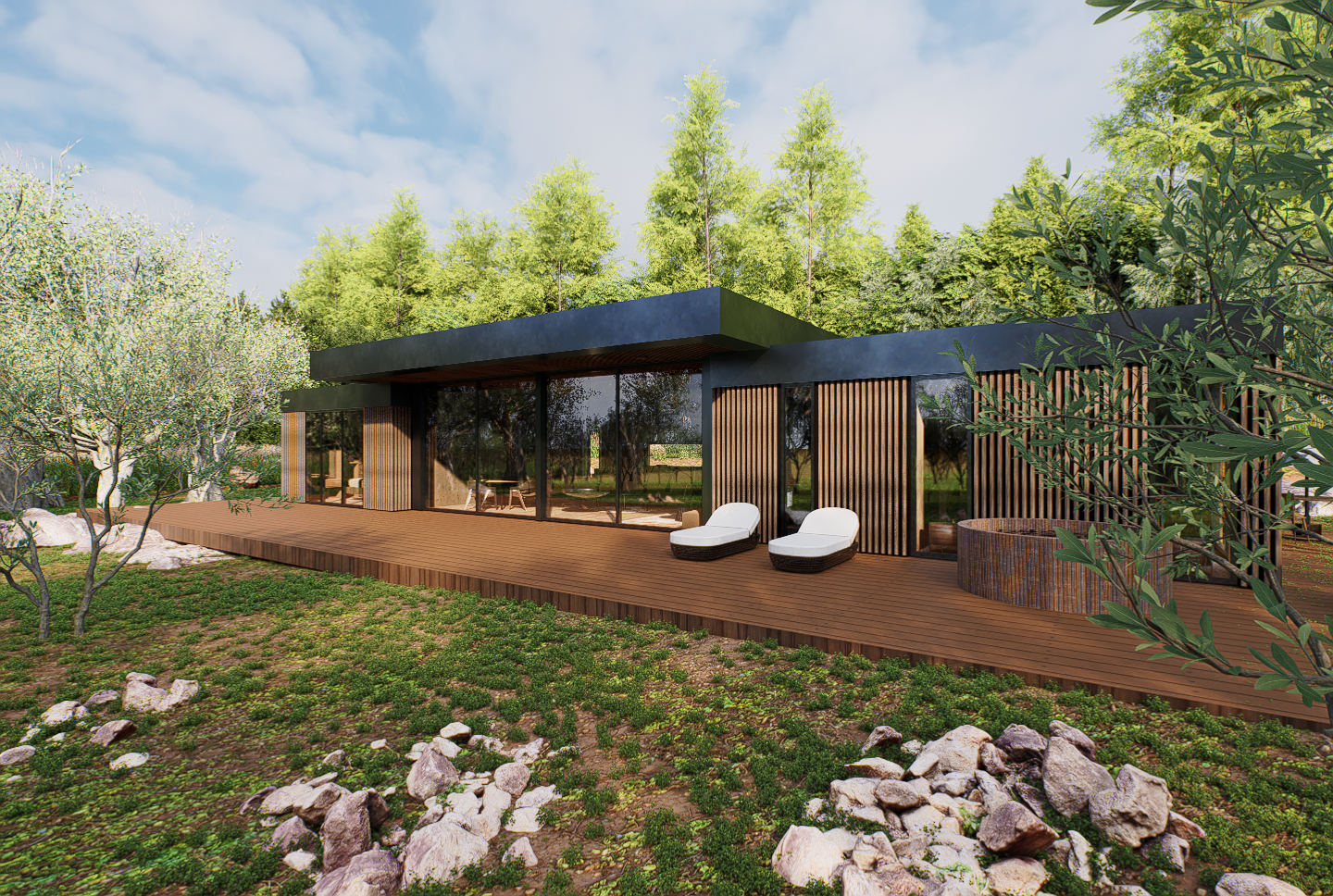
Queensland's Granite Belt is a cool-climate wine region 800 metres above sea level — three hours from Brisbane, and a world away from the coast. With 50+ vineyards and 35+ cellar doors within a 100km radius, it's one of Australia's most underrated wine destinations. Nicolau Estate sits in the heart of it, at Severnlea, with four biodynamic farmstay cottages open from December 2026.
The Granite Belt sits at roughly 800 metres above sea level — higher than most of Victoria's cool-climate regions. The altitude means cold nights even in summer, slow ripening, and wines with a precision and aromatic intensity that flat-country regions simply can't replicate.
Diurnal temperature variation of 15–20°C during vintage means acids hold, sugars develop slowly, and aromatic compounds accumulate. Think of it as the region's natural climate cellar.
The region takes its name from the underlying geology — deep, free-draining granite soils that stress the vines just enough. Lower yields, more concentrated fruit, wines with mineral backbone.
Shiraz, Cabernet Sauvignon, and Malbec for reds. Chardonnay, Vermentino, and Viognier for whites. Emerging varieties like Saperavi and Fiano doing things you're not finding elsewhere in Australia.
50+ vineyards within a 100km radius means you can do a serious wine trail without spending half your day on the road. Cellar doors are close, and they're mostly not crowded.
A new generation of producers is building around local produce and seasonal menus. The region's food culture is evolving fast — from pub classics to paddock-to-plate restaurants.
Each cottage opens onto the vineyard or the farm. Collect eggs for breakfast. Walk to the cellar door in the evening. This is the Granite Belt experienced as a resident, not a tourist.
Nicolau Estate is a working biodynamic farm at Severnlea, Queensland — positioned on the Granite Belt at 800 metres altitude where the region's cool-climate wines are grown. Four architecturally distinct eco cottages sleep up to six guests each, opening onto the vineyard or the farm's kitchen garden.
Unlike conventional Stanthorpe accommodation, guests here live inside the region's food and wine system. Eggs from the henhouse. Vegetables from the garden. Wine from the vines beside your cottage. The cellar door is a short walk; the region's 35+ other cellar doors are a scenic drive away.
Nicolau Estate is certified biodynamic — no synthetic inputs, closed-loop farming, annual certification through Australian Certified Organic. This is the only biodynamic farmstay on the Granite Belt.
3-bed, 3-bath. Sleeps 6. Opening 20 Dec 2026.
Certified organic. Eggs, vegetables, and wine from the property.
The altitude that shapes the region's wine shapes your stay too — cool nights, crisp mornings, star-filled skies.
Drive it in a day or make a long weekend of it. The region rewards the journey.
The Granite Belt's cellar door circuit can be tackled in a weekend. These picks cover the region's diversity — from established names doing traditional varieties well to small operations pushing boundaries. Drive between them; that's part of the point.
One of the region's founding estates. Cabernet and Shiraz done in a classical framework — structured, age-worthy, built for the cellar. Their cellar door is a converted barn and the tasting line-up reflects decades of winemaking practice.
Using estate-grown fruit to make small-batch gin and brandy. The cellar door experience is different — you're tasting through the lens of the region's fruit character applied to spirits rather than wine. Interesting and well-executed.
A small operation focused on alternative Italian and Iberian varieties. If you're bored of the standard Shiraz-Cab-Chard circuit, this is where to go. Saperavi, Fiano, Montepulciano — all from a small dedicated vineyard block.
The cellar door has one of the best views in the region — looking out over granite boulder fields toward the ranges. The wines are solid and consistent. Good place to take a break mid-trail, especially for guests who want more than wine.
Our cellar door is a short walk from your cottage. Small-batch, biodynamic wines made from estate-grown fruit — Vermentino, Chardonnay, Shiraz. Tastings available for farmstay guests by appointment.
Nicolau Estate's cellar door sits at the heart of the property — a short walk from all four cottages, through the vines, to the shed where the wines live. There's no formal cellar door building; the tasting happens where the wine is made. That's the whole point.
The tasting is informal and conversational — not a structured flight with a scorecard. We work through the current releases, talk about what the season was like, and pour side by side with whatever's open from the previous vintage. We don't do flights for their own sake; we pour what we think tells the story of the estate right now.
Expect to taste three to five wines, including our Vermentino (the variety the altitude rewards most), our oldest-block Shiraz, and whatever Chardonnay is showing best. We don't keep library wines back — if a wine is ready to drink, it's open.
Our anchor variety. Textured, saline, built for food. Made to drink young, not to age. Best expression of the estate's altitude and granite.
A small parcel from our oldest vines. Fermented and aged in older oak. The regional identity comes through clearly — cool-climate precision, mineral backbone, no heavy oak.
From our oldest block — a single vineyard parcel we treat differently to the rest of the vineyard. Whole-berry ferment, open-top, minimal handling. Spiced, structured, built for the cellar.
The tasting is available for farmstay guests by appointment. You don't need to plan it ahead — if the weather is good and the winemaker is around, it's as simple as a walk through the vines.
It's not a production cellar door. There are no set session times, no formal tasting notes handed out, no queues. If you're staying at the estate, this is part of the experience — not an add-on. Most guests do it at dusk, after the day's drive around the region, as a way to close the loop on what they've been tasting elsewhere.
If you're not staying at the estate but want to visit the cellar door, send us a message. We accommodate outside guests when we can — the schedule depends on the season and what we're doing in the vineyard.
On the estate at Severnlea. Walk from any cottage — no car needed for farmstay guests.
By appointment for all guests. Best times: late afternoon, 4–6pm. Light antipasto provided.
Complimentary for farmstay guests. Outside visitors: by arrangement. No set tasting fee.
Email gabriel@nicolauecofarm.com with your dates and we'll let you know what's possible.
The wine you're tasting comes from an estate with no synthetic inputs — no herbicides, no pesticides, no synthetic fertilisers. The soil is managed through compost preparations, cover crops, and the animals on the property. This isn't marketing. It's the reason the wines taste the way they do. We'll show you the compost, the cover crop mix, and the block where the Shiraz grows — if you want to see it.
The Granite Belt is reachable from Brisbane in under three hours via the Toowoomba and Cunninghams Gap route — a scenic drive through the Darling Downs and into the highlands. Stanthorpe is the region's main town, 15 minutes from Nicolau Estate at Severnlea. Accommodation books out in peak seasons — plan ahead for autumn vintage and school holidays.
~3 hours via Toowoomba and Warwick. Scenic route through Cunninghams Gap.
~6 hours via New England Highway. Stop at Tenterfield on the way.
Autumn (Mar–May) for harvest scenery; winter mornings are crisp and clear.
The Granite Belt is a year-round destination. Each season changes what's growing, what's in the winery, and what you'll find on cellar door menus. Here's what to expect.
Vine shoots are emerging, the farm is green, and wildflowers are out across the district. Mild temperatures make it ideal for walking the vineyards and visiting cellar doors before the summer crowds arrive.
Warm days, cool nights. The vineyard is in full canopy, the farm is producing, and most cellar doors have seasonal offerings on the tasting bench. Peak season — book accommodation early.
Vintage time. This is when the region is most alive — harvest activity in the vineyard, ferments in the winery, and the smell of fermenting grapes across the whole area. If you only visit once, autumn is the season.
Cold, clear nights and crisp mornings. The vines are dormant, but cellar doors are warm and unhurried. This is the best time for a proper long tasting — winemakers are more available and you're not sharing the bench with crowds.
The Granite Belt rewards slow mornings and unhurried evenings. Book a cottage and experience it from the inside.